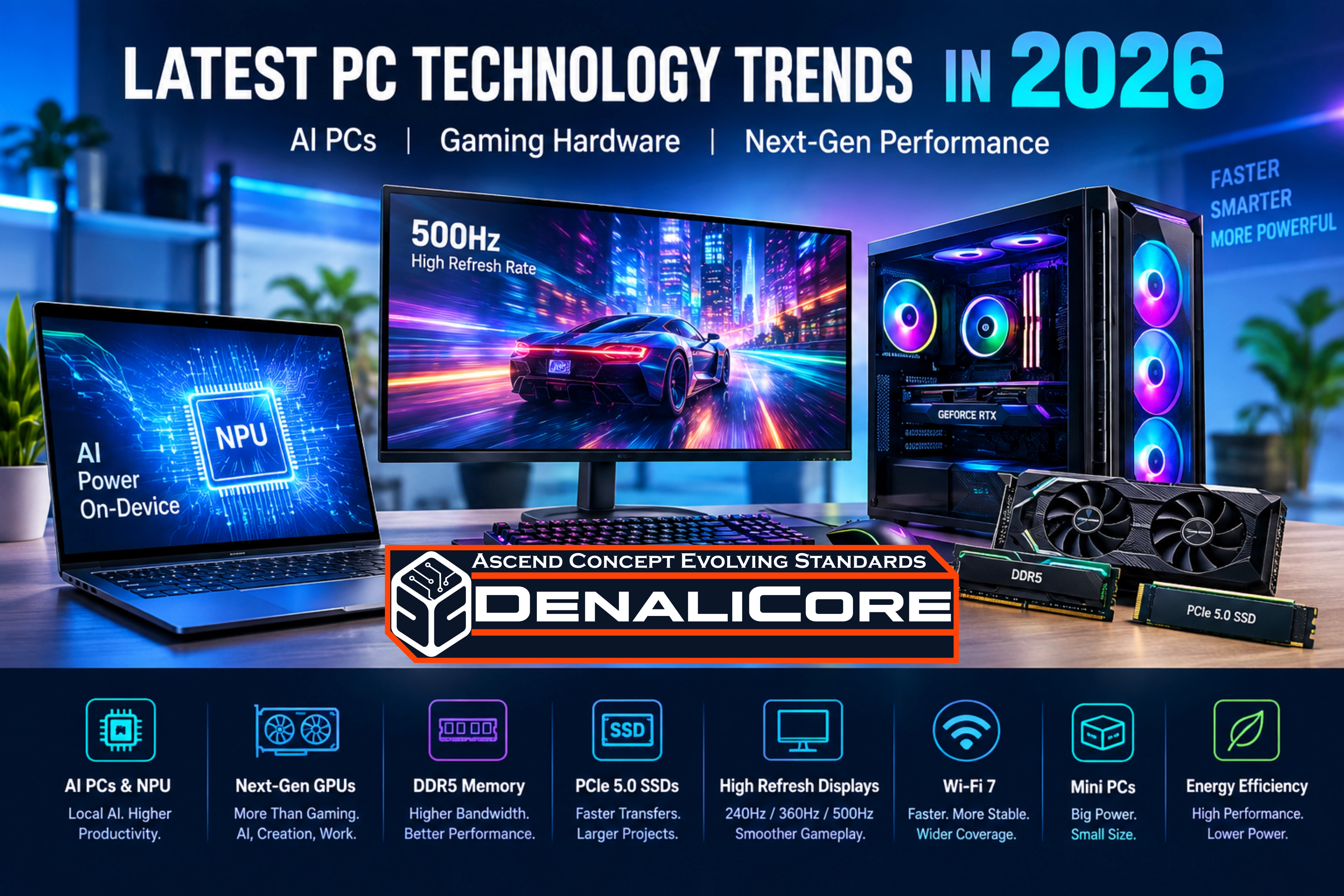
Latest PC Technology Trends in 2026: The Future of PCs, AI, Gaming & Computing
Discover the latest PC technology trends in 2026, including AI PCs, NPUs, next-gen GPUs, DDR5 memory, faster SSDs, Windows 11, Wi-Fi 7, gaming monitors, and the future of PC building.
PC Technology Is Changing Fast in 2026
The PC industry is entering another major transformation in 2026. Artificial intelligence is no longer limited to cloud services or data centers. It is becoming part of the PC itself through dedicated Neural Processing Units (NPUs), AI-optimized processors, local AI software and increasingly powerful GPUs.
At the same time, PC builders and buyers are seeing major changes in memory, storage, graphics, displays, connectivity, cooling and PC form factors.
Microsoft describes modern AI PCs as systems designed to perform AI workloads directly on the device, with NPUs handling tasks such as translation, intelligent search and image generation. Current Copilot+ PC requirements include an NPU capable of at least 40 TOPS, alongside at least 16GB RAM and a 256GB SSD.
So, what are the latest PC technology trends in 2026, and what should consumers, gamers, businesses and PC builders actually pay attention to?
Let’s explore the biggest trends shaping the PC industry this year.
AI PCs Are Becoming the New Standard
One of the biggest PC technology trends in 2026 is the rapid growth of AI-powered computers.
Traditional PCs primarily depend on the CPU and GPU. Modern AI PCs add another important component: the NPU, or Neural Processing Unit.
An NPU is specifically designed to handle AI workloads efficiently while consuming less power than performing the same tasks entirely on a CPU or GPU.

What can an AI PC do?
Modern AI PCs can support:
- AI-assisted writing
- Real-time translation
- Image generation
- Background removal
- Video effects
- Intelligent search
- Voice processing
- Local AI assistants
- AI-powered productivity applications
- On-device language models
The biggest advantage is that some AI processing can happen locally instead of entirely in the cloud.
That can mean faster response times, lower cloud dependency and potentially better privacy for certain workloads.
NPU Performance Is Becoming an Important PC Specification
For years, consumers primarily compared:
CPU + RAM + GPU + SSD
In 2026, another specification is becoming increasingly important:
NPU TOPS
TOPS means trillions of operations per second.
Microsoft’s Copilot+ PC category requires NPUs capable of at least 40 TOPS.
This means buyers looking for a future-ready AI PC should not only ask:
“How fast is the processor?”
They should also ask:
“How capable is the NPU?”
This is particularly relevant for people using AI productivity tools, content creation software, local AI models and intelligent Windows features.
Local AI and On-Device AI Are Growing
Another major trend is the move from cloud AI to local AI.
Instead of sending every AI task to a remote server, newer computers can perform certain workloads directly on the PC.
This creates several potential advantages:
Faster processing → Less dependence on internet → Better offline functionality → Greater control over data
Microsoft specifically highlights local AI processing for tasks such as writing assistance, image editing and intelligent system features.
For businesses, this could become particularly important when working with confidential documents, internal information and proprietary data.
AI Is Increasing Demand for RAM and Memory Bandwidth
AI isn’t only changing processors and GPUs.
It is also changing the economics of PC memory.
The AI infrastructure boom is putting significant pressure on memory manufacturing capacity. TechSpot reported in its 2026 PC buying guide that demand for HBM, server DRAM and enterprise NAND is affecting consumer memory and SSD availability.
That makes memory an increasingly important consideration when building a PC.
For mainstream systems, 16GB RAM remains a reasonable baseline for many users, while:
- 32GB is increasingly attractive for power users
- 64GB is useful for professional workloads
- 128GB+ becomes relevant for advanced AI, development and workstation applications
The right amount ultimately depends on workload rather than simply buying the largest number.

DDR5 RAM Continues to Dominate Modern PC Builds
DDR5 has become an important foundation for modern desktop and laptop computers.
Compared with older DDR4 platforms, DDR5 provides higher memory bandwidth and supports newer processor platforms.
However, 2026 is an unusual time for PC builders because memory pricing and availability are being affected by broader AI-related demand.

GPUs Are Becoming More Than Gaming Hardware
Graphics cards remain essential for gaming, but their importance goes far beyond gaming.
Modern GPUs are increasingly used for:
- AI inference
- AI image generation
- 3D rendering
- video editing
- machine learning
- scientific computing
- professional visualization
- content creation
The AI boom is also influencing GPU architecture and memory requirements. Research into next-generation GPU architectures increasingly focuses on chiplets, larger SRAM capacity, memory bandwidth and more efficient data movement.
This means the question is no longer simply:
“How many FPS can this GPU produce?”
For professional users, the better question can be:
“What workloads can this GPU accelerate?”
Gaming PCs Are Moving Toward Higher Refresh Rates
Gaming displays continue to evolve rapidly.
High-refresh-rate gaming monitors are moving well beyond the traditional 144Hz and 165Hz categories.
At IFA 2026, Acer showcased a gaming monitor capable of reaching 500Hz, demonstrating how manufacturers continue pushing refresh rates for competitive gaming.
For competitive gamers, high refresh rates can provide smoother motion and lower perceived latency when paired with hardware capable of delivering sufficiently high frame rates.

OLED and QD-OLED Gaming Monitors Are Becoming More Popular
Another important display trend is the continued growth of OLED and QD-OLED monitors.
These displays offer advantages such as:
- deep blacks
- high contrast
- fast response times
- excellent HDR potential
- strong image quality
The 2026 computing market is seeing OLED displays move further into gaming and productivity systems, with multiple OLED and QD-OLED displays receiving recognition in major computing awards.
For users who want one monitor for both gaming and content creation, OLED technology is becoming increasingly attractive.

PCIe 5.0 SSDs Are Becoming More Relevant
Storage is another area experiencing significant change.
Modern systems are increasingly adopting high-speed NVMe SSDs, particularly PCIe 5.0 drives.
These drives can offer extremely high sequential transfer speeds compared with older PCIe generations.
However, faster does not automatically mean better for every user.
For everyday office work, browsing and gaming, a quality PCIe 4.0 NVMe SSD can still provide excellent performance.
PCIe 5.0 becomes more interesting for:
- professional video editing
- large file transfers
- workstation workloads
- content creation
- high-end PC builds
- demanding data-intensive applications
Wi-Fi 7 Is Becoming an Important PC Connectivity Upgrade
Wireless networking is also moving forward.
Wi-Fi 7 is becoming an increasingly important feature in modern PCs, laptops and networking equipment.
Its advantages include higher potential throughput, improved multi-link connectivity and better performance in demanding wireless environments.
For users with compatible networking hardware, Wi-Fi 7 can help reduce the need for wired connections in certain high-bandwidth applications.
Interestingly, new 2026 mini PCs are already combining AI-capable processors with Wi-Fi 7, Thunderbolt 4 and high-speed Ethernet connectivity.

Mini PCs Are Becoming More Powerful
The days when a mini PC was automatically considered a low-performance computer are disappearing.
Modern mini PCs can include:
- powerful CPUs
- integrated graphics
- dedicated NPUs
- large amounts of DDR5 memory
- fast NVMe storage
- Wi-Fi 7
- multiple display outputs
- high-speed Ethernet
For example, MSI’s 2026 Cubi NUC AI+ 3MG combines a compact design with Intel’s newer processor platform, up to 128GB DDR5 memory, Wi-Fi 7 and support for multiple 4K displays.
This makes mini PCs attractive for:
- offices
- digital signage
- home servers
- developers
- small businesses
- media centers
- home offices
Developer PCs Are Becoming Specialized for AI
A particularly interesting 2026 development is Microsoft’s Project Zenith.
Microsoft announced a developer-focused Windows experience designed for developer-class devices with at least 64GB unified memory and 250+ GB/s memory bandwidth.
The idea is to create systems that are ready for software development and local AI workloads without requiring developers to spend significant time configuring their environment.
This reflects a larger trend:
The PC is becoming a specialized AI workstation rather than simply a general-purpose computer.
More PCs Are Being Designed Around Efficiency
Performance is no longer the only measurement manufacturers care about.
Power efficiency is becoming increasingly important.
This is particularly noticeable in:
- laptops
- mini PCs
- AI PCs
- thin-and-light computers
- business PCs
An efficient processor can deliver strong performance without generating as much heat or consuming as much power.
For laptops, this can translate into better battery life.
For desktop systems, it can mean:
Lower power consumption + less heat + quieter cooling + better efficiency
ARM-Based PCs Continue to Challenge Traditional x86 PCs
Another important development is the continued growth of ARM-based Windows computers.
ARM platforms can provide strong efficiency and battery-life advantages, while traditional x86 processors remain extremely important for compatibility and high-performance desktop computing.
For consumers, the choice increasingly comes down to:
ARM vs x86
rather than simply:
Intel vs AMD
Compatibility, software support, performance and workload requirements should all be considered before purchasing.
AI Is Changing the Way We Choose a PC
Perhaps the biggest trend isn’t a particular processor, GPU or SSD.
It is how people evaluate computers.
Previously, a buyer might ask:
“How many GHz is the CPU?”
Now they may ask:
“Can this PC run AI applications?”
Instead of only asking about RAM:
“How much RAM do I need for my workload?”
Instead of only asking about GPU FPS:
“Can this GPU handle my gaming, editing and AI workload?”
This represents a fundamental shift in PC purchasing.
What Should You Look for When Buying a PC in 2026?
There is no single “best PC” for everyone.
The correct configuration depends on what you actually do.
| User Type | Recommended Focus |
| Office / Business | Efficient CPU, 16–32GB RAM, NVMe SSD, strong connectivity |
| Student | Efficient CPU, 16GB+ RAM, SSD, good battery life |
| Gaming | Strong GPU, modern CPU, 32GB RAM, fast SSD |
| Content Creator | Powerful CPU/GPU, 32–64GB RAM, fast NVMe storage |
| AI User | NPU, powerful GPU, 32–64GB+ RAM |
| Developer | Strong CPU, 32–64GB+ RAM, fast SSD |
| AI Developer | High memory capacity, high bandwidth, powerful GPU/NPU |
| Workstation | High-core CPU, professional GPU, 64GB+ RAM |
| Home Server | Efficient CPU, high storage capacity, networking |
Frequently Asked Questions About PC Technology in 2026
What is the biggest PC technology trend in 2026?
- The biggest trend is the integration of AI directly into PCs through NPUs, AI-optimized processors, local AI software and increasingly powerful GPUs.
Are AI PCs worth buying in 2026?
- For users who regularly use AI-powered applications, local AI features or productivity tools, an AI PC can be a good long-term investment. For basic browsing and office work, a conventional modern PC may still be sufficient.
How much RAM should a PC have in 2026?
- 16GB is a reasonable starting point for general use. 32GB is increasingly attractive for gaming and demanding multitasking, while 64GB or more makes sense for professional workloads, development and advanced AI applications.
Is DDR5 RAM worth it in 2026?
- Yes, particularly when building a new PC around a modern processor platform. DDR5 is now an important part of current-generation PC platforms.
Are mini PCs good in 2026?
- Yes. Modern mini PCs can deliver surprisingly strong performance while using significantly less physical space than traditional desktop computers.
Will AI replace traditional CPUs and GPUs?
- No. AI workloads are encouraging systems to become more heterogeneous, with CPUs, GPUs and NPUs handling different types of work.
The Future of PC Technology
The PC of 2026 is becoming much more than a faster version of the PC from previous generations.
The biggest transformation is the combination of CPU + GPU + NPU + high-speed memory + fast storage + intelligent software.
AI is increasingly moving from the cloud onto the actual computer. Microsoft is already positioning AI PCs around local processing, while specialized systems such as Project Zenith show how PCs are being configured around AI development and high-memory workloads.
At the same time, gaming continues pushing GPU performance and display refresh rates, while mini PCs are becoming increasingly capable.
For consumers and businesses, the smartest approach isn’t necessarily to buy the most expensive PC available.
Instead, choose hardware based on your actual workload, upgrade requirements, AI needs, gaming requirements, software compatibility and expected lifespan.
The future of computing isn’t simply about making PCs faster. It’s about making PCs smarter, more efficient and more capable of understanding and assisting the people who use them.

Leave a Reply